











Why The Switch Is About More Than Just "Cold Water"
For many divers, the transition from a wetsuit to a drysuit is seen as a specific tool for a specific environment: you only switch when the water gets freezing. It is viewed as a "graduation ceremony" reserved for ice divers or deep technical explorers.
However, this perspective misses the bigger picture. In reality, the shift from wet to dry is less about temperature and more about redefining comfort, exposure, and control underwater.
A drysuit does not just keep you warm. Its primary function is simple but powerful: it keeps you dry. That total separation from the water fundamentally changes how your body responds to long dives, repetitive exposure, and demanding environments.
1. The Physiology of "Long-Term" Exposure
One of the most common misconceptions is that drysuits are unnecessary in temperate waters (20°C - 26°C). While a 5mm or 7mm wetsuit feels fine for a single 45-minute dive, the equation changes when you are doing two, three, or four dives a day—or a single technical dive lasting 90+ minutes.
The Skin Barrier
In a wetsuit, you are soaking in a cocktail of saltwater, plankton, and microorganisms for hours. Prolonged exposure causes your skin to absorb water and soften (a process called maceration), making it highly vulnerable to cuts, abrasions, and infections. A minor scrape against a wreck that would be harmless on land can become a significant infection after hours of soaking.
Thermal Debt
Water conducts heat away from the body 20 to 25 times faster than air. Even in "warm" water, you are slowly bleeding energy. This accumulates over a dive trip as "thermal debt," leading to deep fatigue. By diving dry, you eliminate this conductive loss almost entirely. You finish the dive with dry skin and high energy levels, ready for the next objective.
2. The Technical Standard: Redundancy
In the world of technical diving, a drysuit is widely considered essential equipment, not for comfort, but for safety.
Technical divers carry significant equipment loads: twinsets, deco stages, scooters, and canister lights. Achieving perfect trim and buoyancy is a complex balancing act. While your Wing (BCD) is your primary lift source, you must ask yourself: What happens if my wing fails?
❌ In a Wetsuit
You rely solely on your wing. If the bladder bursts or the inflator fails, you are negatively buoyant with no backup lift source. You become a falling object.
✅ In a Drysuit
The suit acts as a Redundant Buoyancy Device. By closing the exhaust valve and adding gas, you can generate enough lift to arrest a descent and safely ascend, even with a total BCD failure.
This redundancy makes the drysuit a foundational element of the GUE and technical diving curriculum. It provides a safety margin that neoprene simply cannot offer.
3. Material Science: Why It Matters
Not all drysuits are created equal. One of the biggest differences between manufacturers lies in material selection and construction philosophy. If you are investing in a drysuit, you need to understand the difference between "keeping dry" and "high performance."
Standard Trilaminate vs. High-Performance Materials
Most standard suits use a butyl-based trilaminate. It is lightweight and dries quickly, but it lacks stretch. To allow movement, manufacturers must cut the suit "baggy." This excess fabric creates drag (hydrodynamic resistance) and creates pockets where air can get trapped, destabilizing your trim.
The SF Tech Difference
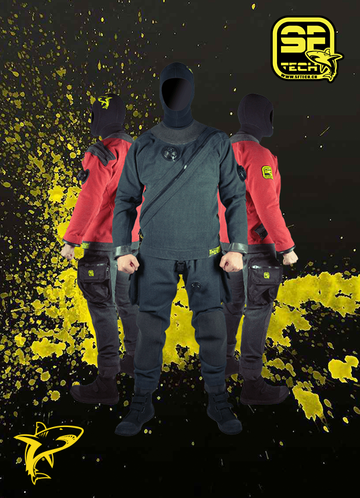
This is why we partner with SF Tech. They utilize advanced materials like High-Density Neoprene and Kevlar® reinforcement.
- Kevlar®: Located in high-stress areas (knees, elbows, shoulders), this allows you to crawl through caves or work on wrecks without fear of puncture.
- Tailored Fit: Because the material is stronger and has specific stretch characteristics, the suit can be cut closer to the body—like a tuxedo. This reduces drag, reduces the amount of gas needed to dive, and makes swimming effortless.
4. The "Learning Curve" Myth
Many divers hesitate to switch because they fear the learning curve. They have heard horror stories of divers floating feet-first to the surface.
While formal training is required, modern, well-fitted drysuits are remarkably intuitive. The "floaty feet" phenomenon is almost always a result of poor fit (suits that are too long in the leg) or improper weighting.
Once mastered, diving dry is actually easier than diving wet. You don't deal with the compression of neoprene at depth, meaning your buoyancy characteristics stay consistent whether you are at 10m or 40m.
A Practical Investment
Choosing a drysuit is not about chasing status. It is a practical decision driven by safety, redundancy, and long-term performance. Once you experience the stability of diving dry, going back feels like a compromise.
Interested in SF Tech quality? Stop by our showroom for a fitting.
Explore SF Tech Drysuits


